Seasonal
Gwanghallu Pavilion Visitor Guide — History & Chunhyang Story
Step into a timeless Korean love story at Gwanghallu Pavilion, a national treasure steeped in legend and architectural beauty.
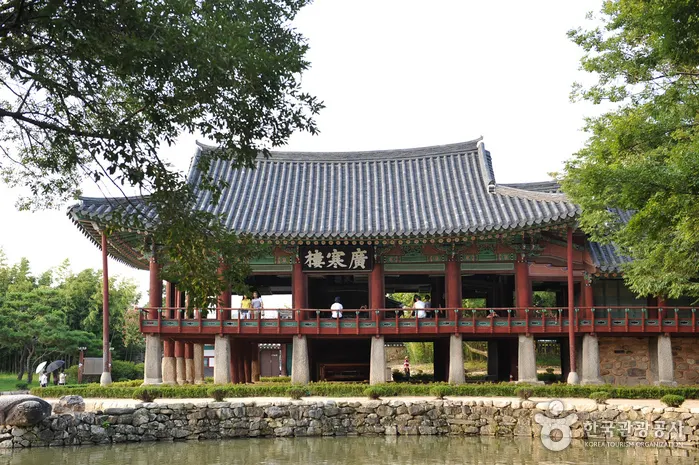
Rebuilt in 1638 (the 16th year of King Injo), Gwanghallu Pavilion is one of the Joseon dynasty’s most exemplary structures. The pavilion was constructed in 1419 by Hwang Hui, a noted prime minister in the early Joseon dynasty, during his exile to Namwon. The name of the pavilion at that time was Gwangtongnu. In 1434, while the pavilion was undergoing reconstruction, scholar and politician Jeong In-ji called it Gwanghallu after Gwanghancheongheobu, the mythical palace on the moon. Designated as Treasure No. 281, the pavilion is one of four major pavilions known for excellent craftsmanship, along with Yeongnamnu Pavilion (Miryang), Chokseongnu Pavilion (Jinju), and Bubyeoknu (Pyeongyang). Gwanghalluwon Garden, which consists of Gwanghallu Pavilion, a pond, Bangjangjeon Pavilion, and Yeongjugak Pavilion form Historic Site No. 33.
Why Gwanghallu Pavilion matters


Official visitor information
Official address: 1447, Yocheon-ro, Namwon-si, Jeonbuk-do.
Official visiting hours: April-October: 08:00-21:00 (18:00-21:00 Free admission) · November-March: 08:00-20:00 (18:00-20:00 Free admission).
Official closure information: N/A (Open all year round).
Parking: Available.
Official information contact: • 1330 Travel Hotline: +82-2-1330 · (Korean, English, Japanese, Chinese) · • For more info: +82-63-620-6172.
Additional official details
Admission Fees: Individuals: Adults 3,000 won / Teenagers 2,000 won / Children 1,500 won · Group: Adults 2,500 won / Teenagers 1,500 won / Children 1,000 won · · * Adults (ages 19-64), Teenagers (ages 13-18), Children (ages 7-12) · * Group: 30 people or more · * Free admission: Preschoolers (ages 6 and younger) & senior citizens (ages 65 and older).
Parking Fees: * Sedan: 2,000 won (one-day parking) / 30,000 won (monthly parking) · * Mini Bus (15 seats or under): 2,000 won (one-day parking) / 30,000 won (monthly parking) · * Bus (16 seats or more): 4,000 won (one-day parking) / 60,000 won (monthly parking) · * Truck (1 ton or under): 2,000 won (one-day parking) / 30,000 won (monthly parking) · * Truck (over 1 ton): 3,000 won (one-day parking) / 45,000 won (monthly parking).
How to use this guide
Use the official information above as the planning baseline. Opening arrangements, programs, admission conditions, and access rules can change after this review. Follow the official source links before traveling, especially when your visit depends on a particular exhibition, performance, seasonal activity, or facility.
The remaining recommendations on this page are editorial guidance for understanding the setting and organizing a visit. They are not a substitute for instructions issued by the venue, local government, cultural-property authority, or transport operator.
Responsible visit checklist
Before leaving
- Open the official venue page and confirm the latest operating notice.
- Check weather and transport conditions on the day of travel.
- Respect residential, religious, ecological, and cultural-property rules where applicable.
- Allow flexibility rather than relying on an exact minute-by-minute schedule.
- Use the official information contact when accessibility or reservation details are essential.
Where is Gwanghallu Pavilion?
1447, Yocheon-ro, Namwon-si, Jeonbuk-do
Where should I confirm current hours and closures?
Use the official source links in the reviewed-for-accuracy panel on this page.
When was this information checked?
The reviewed-for-accuracy panel shows the latest human review date and source record.