Seasonal
Jeju Stone Park: Walk the Creation Myth
Treat Jeju Stone Park as a landscape walk, not a quick museum stop, and follow the route built around the Seolmundae Halmang creation myth.
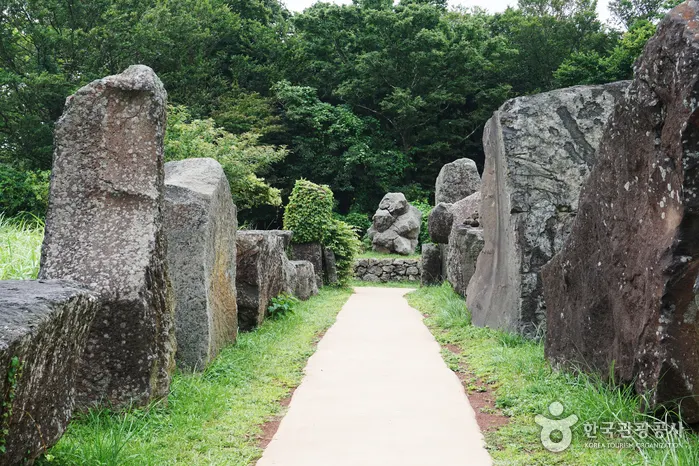
Every English-language rewrite of Jeju Stone Park calls it a 'stone museum with folklore village.' That description sets visitors up to fail. The site is 3.269 square kilometers — 327 hectares of volcanic scrubland deliberately left semi-wild — and the actual exhibition buildings occupy less than a tenth of that. If you walk in expecting a museum, you'll clear the first hall in 40 minutes, wonder what all the fuss is about, and leave before you've even reached the part that gives the park its meaning. The park is the walk. The exhibits are punctuation. Once you understand that, it becomes one of the most quietly ambitious cultural sites in Korea.
One goddess, one landscape — why the layout matters
The park is built around a single Jeju myth: Seolmundae Halmang (설문대할망), the giant grandmother creator goddess of Jeju shamanism. In the myth she scooped up dirt in her skirt, poured it into the sea to create Jeju's roughly 360 oreum (parasitic volcanic cones), and finally raised Hallasan as the island's spine — using it as her pillow when she rested. One of her death legends says she fell into a pot of rice porridge she was cooking for her 500 sons; the sons, discovering what they had eaten, wept themselves into stone and became the 500 Yeongsil Rocks visible today on Hallasan's western slope.
The park's three courses are laid out as a physical retelling of that myth. You don't have to know it going in — the plaques explain — but knowing it changes the experience. The Garden of Legends is the birth of the world. The Outdoor Stone Culture Exhibition is what humans did with what Seolmundae made. The Traditional Thatched Village is who those humans became. Walk the three in that order and the park reads as a single continuous argument. Walk them out of order (or skip Course 3, as most visitors do) and it feels like a random sculpture park. That's the trap.
Course 1 — Garden of Legends: do this first, while your legs are fresh
The main entry path is called the Path of Legends, and it opens onto the Garden of Legends — a broad landscaped walk anchored by the 500 Generals Gallery (오백장군 갤러리) and the 'Mother's Room' area, also called the Garden of Myths. This is where the Seolmundae Halmang story is spatially told. The 500 stone piles you'll see across the meadow correspond to the 500 sons of the myth; the Mother's Room references the porridge-pot legend.
In June 2025 the park opened its new dedicated Seolmundae Halmang Exhibition Hall on this course, which is worth the detour — it consolidates the folklore, shamanic ritual objects, and the geological explanation of Jeju's volcanic origin into one hall. If you have limited time and can only see one indoor exhibit, see this one, not the older Stone Museum first. It's the emotional key to the rest of the park.
Practical note: the Path of Legends starts as a broad, mostly flat forest trail. It's easy walking but there is real distance here — the Garden of Legends alone can absorb 60-90 minutes if you actually stop and read. Most visitors underestimate this and rush it because they're saving energy for the museum. Don't. The museum can be skimmed; the outdoor course cannot.
Course 2 & 3 — the exhibition huts and the thatched village most visitors never reach
Course 2 is the Outdoor Stone Culture Exhibition — a series of small traditional thatched huts spread across the landscape, each displaying stone artifacts from a specific era or use: prehistoric grinding stones, tomb guardians, mills, salt-making stones, roof weights, boundary markers. If you have ever visited a normal ethnographic museum, this format will feel odd at first — the objects aren't in glass cases; they're outdoors, on the ground where similar objects would have originally sat. That's the point. You are supposed to walk between them, not queue past them.
Course 3, the Jeju Traditional Thatched Village, is the finish line, and it's the one most day-trippers cut. It reconstructs three types of traditional Jeju thatched houses — saegeorijip (three-bay house), dugeorijip (two-bay house), and horse-mill outbuildings — using the actual porous black basalt walls that Jeju homes were built from because there was no other affordable material on a volcanic island. Standing inside a one-room saegeorijip you can feel why Jeju vernacular architecture looks nothing like mainland Korean hanok: the stone is doing the structural work the wood does elsewhere. This is the part of the park that closes the argument the myth opened.
Dol harubang — what those guardian stones actually mean
The stone grandfathers you'll pass throughout the park — bulging eyes, mushroom hats, hands on the belly — are called dol harubang (돌 하르방). They are carved from Jeju's porous volcanic basalt (which is why every one you see has small round holes in it). The current dol harubang design was formalized in 1971, when the statues were officially designated Jeju folk heritage, but the stone-guardian tradition goes back at least to the early Joseon period (around 500 years ago). Historically they stood at the gates of Jeju's three main fortress towns as protector figures — closer to Korean village jangseung than to any temple guardian. The mass-produced souvenir versions you see at Jeju Airport are cute; the ones inside Jeju Stone Park are older, weathered, and mounted in the landscape roughly as they were meant to be seen.
Timing, transport, and what to pair it with
Realistic time budget: 3 to 4 hours if you walk all three courses at a normal pace. Faster visitors have finished in 2 hours; nobody who took it seriously finished in under 2. If you can only give it 90 minutes, prioritize Course 1 (Garden of Legends + Seolmundae Halmang Hall) and skip the rest — walking Course 2 and 3 at a rushed pace defeats the point.
The park sits in Jocheon-eup on Jeju's northeast, roughly 30-40 minutes by car from Jeju City. Public transport works (Jeju City bus routes 111 and 112 stop near the entrance) but is slower; most visitors combine the park with other northeast attractions and rent a car for the day. The obvious pair is Manjanggul Lava Tube, 20 minutes further east, which physically shows you the volcanic basalt formation process that the park culturally interprets — walking Manjanggul in the morning and Jeju Stone Park in the afternoon builds a coherent geology-and-culture day. Bijarim Forest (nutmeg-yew grove) is another 20 minutes east from Manjanggul if you have energy left.
Best time of day: arrive at opening (09:00) on a weekday if you can, especially in summer. There is almost no shade on the open sections of Courses 1 and 2, and Jeju's July-August midday sun is brutal on the exposed lava rock. Winter visits are pleasantly cold and empty. Avoid rainy days — the basalt paths are safe but the myth-scale outdoor scale of the park is wasted if you're rushing under an umbrella.
Official visitor information
Address: 2023 Namjo-ro, Jocheon-eup, Jeju-si, Jeju-do (제주특별자치도 제주시 조천읍 남조로 2023).
Opening hours: 09:00-18:00, Tuesday through Sunday. Ticket booth closes at 17:00 (last entry).
Closed: Every Monday (or the next weekday if Monday is a public holiday), January 1, Seollal (Lunar New Year), and Chuseok (Korean Thanksgiving).
Admission: Adults KRW 5,000 · Teenagers KRW 3,500 · Children under 12 and seniors typically free (check on arrival).
Size: Approximately 3.269 square kilometers (327 hectares / 810 acres). The park has been under phased development since groundbreaking in 2001 and reached its currently open configuration in 2021.
Parking: Free on-site parking is available near the main entrance.
Contact: +82-64-710-7733. The park is operated by Jeju Special Self-Governing Province and information is published on the provincial site at jeju.go.kr/jejustonepark.
- Budget 3-4 hours, not 1 — the park is 3.269 sq km and Course 3 (the thatched village) is the underrated finish most visitors skip.
- Walk Course 1 → 2 → 3 in order. The layout tells the Seolmundae Halmang creation myth as a physical sequence, and going out of order collapses the meaning.
- Prioritize the new Seolmundae Halmang Exhibition Hall (opened June 2025) over the older Stone Museum if you only have time for one indoor stop.
- Come at 09:00 opening in summer — Courses 1 and 2 have almost no shade and Jeju midday sun on lava rock is intense.
- Pair with Manjanggul Lava Tube (20 min east) for a geology-then-culture day; skip Bijarim Forest unless you have a full day.
How long do I need at Jeju Stone Park?
Plan for 3-4 hours to walk all three courses at a normal pace. A rushed 2-hour visit is possible but skips Course 3, which is the payoff. If you only have 90 minutes, do Course 1 (Garden of Legends and the Seolmundae Halmang Exhibition Hall) and leave the rest for a return visit.
Is this the same as the Jeju Folk Village Museum?
No — those are two different sites. Jeju Folk Village Museum is in Seogwipo on the south coast and focuses on reconstructing full villages. Jeju Stone Park is in Jocheon-eup on the north coast and focuses on Jeju's stone culture and the Seolmundae Halmang creation myth. They complement each other but the Stone Park is the more architecturally ambitious of the two.
Is it worth going with kids?
It works for kids old enough to walk 3-4 km on their own (roughly 7+). Younger children will get restless — the exhibits are not interactive and the walking distances are real. Strollers are usable on the main paved paths of Courses 1 and 2 but not comfortable on all of Course 3.
Can I get there without a car?
Yes but plan the day around it. Jeju City buses 111 and 112 stop near the park entrance and take roughly 50-60 minutes from Jeju International Airport, versus 30-40 by car. Most visitors rent a car for a full northeast-Jeju day (park + Manjanggul + Seongsan Ilchulbong sunrise the next morning).
Are the dol harubang statues here real antiques?
The current 'dol harubang' design was officially formalized in 1971 as Jeju folk heritage, but the tradition of carved basalt gate guardians on Jeju goes back at least to the early Joseon period. The examples inside Jeju Stone Park include historical statues collected by founding director Paek Un-chol over roughly 40 years, alongside newer commissioned works. They are not the mass-produced souvenirs sold at the airport.
Do I need to book tickets in advance?
No. Tickets are sold at the entrance ticket booth on arrival, and the park's scale means it does not sell out. The only reason to check ahead is to confirm the park isn't closed on your date — Mondays, January 1, Seollal, and Chuseok are the fixed closures.