Itinerary
Bukchon Hanok Village: Visit Before 5 PM
Visit Bukchon as a working residential neighborhood, respect its 10:00-17:00 tourist hours, and follow the official photo-point walking order.
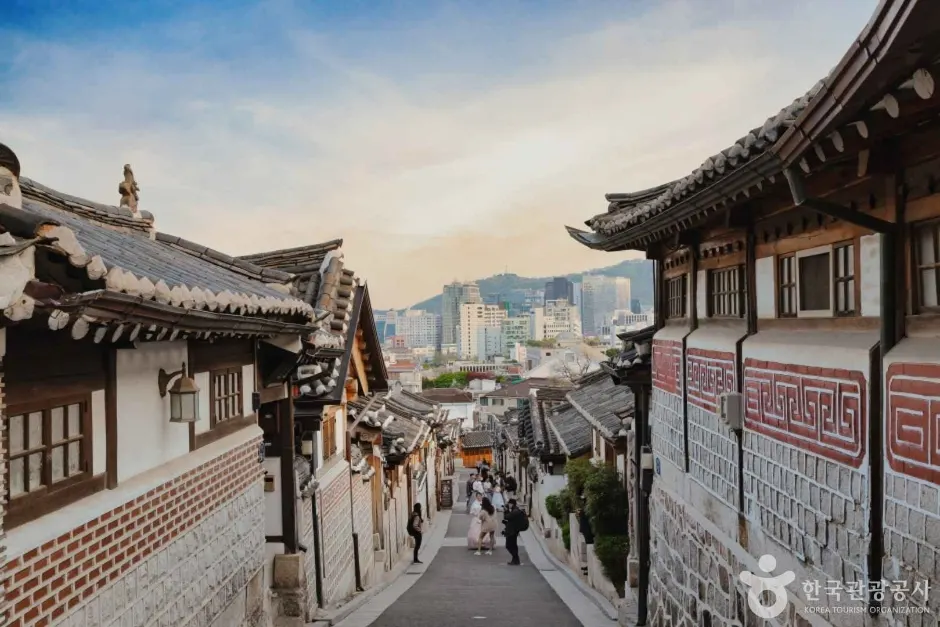
Bukchon Hanok Village received about 6.4 million visitors in 2024. Roughly 6,100 people actually live there. That ratio — a thousand tourists per resident — is why, in November 2024, Jongno-gu district office designated the neighborhood a Special Management Area and closed it to tourism outside of 10:00-17:00. Most guides still describe Bukchon as a picturesque hanok village to wander freely, and that description is now technically incorrect. What follows is what Bukchon actually is, what the new rules mean on the ground, and the right order to walk the eight official photo points (Bukchon Palgyeong) without treating someone's front door like a movie set.
What Bukchon actually is
Bukchon (북촌, literally 'north village') refers to the ridge of narrow streets sitting between two Joseon royal palaces — Gyeongbokgung to the west, Changdeokgung to the east — north of Jongno and the Cheonggyecheon stream that once divided the old capital. Its status as a preferred residential quarter dates back to the early Joseon dynasty (1392-1910), when high-ranking court officials and yangban aristocracy took the plots closest to the palaces they served. A 1906 family register still showed 43.6% of Bukchon's population coming from that class.
The buildings that visitors photograph today, however, are mostly not that old. The great majority of surviving hanok in Bukchon were built between the 1900s and the 1930s, during the late Korean Empire and early Japanese colonial period, when developers subdivided the old aristocratic lots into smaller, denser urban hanok. That is why the streets feel intimate rather than palatial — they were built as middle- and upper-middle-class urban housing, not as noble estates. Roughly 900 traditional hanok remain in the district; the rest of the housing stock is modern low-rise infill.
The crucial word in every official description of Bukchon is residential. Unlike Namsangol or Korean Folk Village, no house has been relocated here for exhibition. People sleep, work, raise children, and receive mail on these streets. The reason non-residents lose access between 17:00 and 10:00 is that families asked for it — resident complaints to Jongno-gu jumped from 56 in 2018 to 202 in 2023 as short-video traffic rose, and the population declined 27.6% over the same window.
The Red Zone rules you need to know before you arrive
As of November 2024, the core Bukchon area — designated a Special Management Area, sometimes called the 'Red Zone' — carries specific rules that overseas guidebooks published before that date do not reflect:
Tourist access is 10:00 to 17:00 only. Outside those hours only registered residents and guesthouse guests may enter the Red Zone streets. Enforcement is currently focused on high-traffic alleys around Gahoe-dong (Views 3-7 below) rather than the broader neighborhood, but a sunset visit is no longer part of the itinerary.
Group size is capped at 10 people. Tour operators with larger groups are asked to split; a guide with 25 clients marching down a single alley is what the rules were designed to prevent.
No amplification. Microphones, megaphones, and portable speakers are prohibited. Tour guides now brief clients before entering rather than narrating inside the streets. A conversational voice is fine; a raised one draws attention immediately.
Do not photograph house interiors, including through gates and windows. Exterior facades, streets, walls, and rooflines are all fine. Anything past a threshold is not.
None of this changes the experience much if you were going to visit respectfully anyway. But if the mental image is a golden-hour selfie session in an empty alley with a rented hanbok at 18:30, that image no longer exists in the Red Zone.
The Bukchon 8 Views, in the walking order that actually works
Jongno-gu identifies eight official viewpoints (북촌 8경, Bukchon Palgyeong). Most posts online scatter them randomly. Walked in numerical order they don't loop cleanly either. The efficient loop, starting and ending at Anguk Station Exit 3, is roughly 2.5 km and takes 90 minutes at a photographer's pace or two hours with proper stops.
View 2 — Wonseo-dong Handicraft Road. From Anguk Station Exit 3, walk north-east toward Wonseo-dong. Old hanok converted to small artisan workshops line the street. Least crowded of the eight — most visitors skip it and start higher up.
View 1 — Changdeokgung Palace view. A short walk east brings you to the point where you can see Changdeokgung's rooftops rising above the neighborhood roofline. Best in morning light with the palace to your east.
View 3 — Gahoe-dong area (approach). Climb west into Gahoe-dong. The classic wide-angle streetscape of tiled rooftops descending in tiers. This is the postcard image of Bukchon.
View 4 — Hill at Gahoe-dong / Bukchon Observatory. The highest reachable point in the walkable area. On a clear day you see Bugaksan behind you and can trace the palace district south. There is a small cafe and rest area here.
View 5 — Uphill road at Gahoe-dong (Bukchon-ro 11-gil, looking up). The same street residents use to get home. Cascading rooftops, cars parked on the side, real washing lines visible. Look up, not into windows.
View 6 — Downhill road at Gahoe-dong (Bukchon-ro 11-gil, looking down). Turn around from View 5. This is the single most-photographed frame on Instagram tagged #bukchon — the alley of hanok rooftops descending toward downtown skyscrapers in the distance. Marshals in yellow vests staff this corner during peak hours.
View 7 — House number 31, Gahoe-dong (beonji 31). A quiet stone-and-tile facade whose exact location is deliberately not signposted to protect the residents. It is a real house. Photograph the wall, not the door.
View 8 — Stone stairway at Samcheong-dong. Walk west out of the Red Zone and down into Samcheong-dong. The old stone steps mark the traditional boundary. From here you are back in a cafe-and-gallery district where the rules relax and you can talk normally again.
When to go and when to skip it
The best window is a weekday between 10:00 and 11:30. You're inside the permitted hours, the tour buses arriving from downtown hotels have not yet reached Anguk Station in force, and the light on the east-facing rooftops is clean. Weekday 15:00-17:00 is a viable second choice; the light is warmer but the crowd is at its densest — and at 16:45 the marshals begin nudging visitors back toward the exits.
Skip it entirely if the only slot you have is a Saturday afternoon in April, May, October, or the first week of November (peak foliage). The View 6 alley in those windows is not so much a street as a queue — 200 hanbok-clad visitors waiting for the same frame, and the atmosphere the guides describe is not the atmosphere you will experience. On those dates, substitute Ikseon-dong (a hanok cafe district 15 minutes south, where the same architecture is served with permission to talk normally) or the Gyeongbokgung palace grounds themselves.
Rainy days are counterintuitively excellent. Crowds thin by two-thirds, the wet grey tiles have a colder blue-black tone that photographers prefer, and you actually hear the neighborhood — a bicycle bell, a kitchen radio, occasionally children — the way a residential district is meant to sound.
What to pair Bukchon with
The natural half-day is Gyeongbokgung Palace in the morning (opens 09:00), a short walk east to Bukchon for the 10:00 opening, the 8-view loop until roughly 12:30, then lunch in Samcheong-dong. Samcheong-dong-gil, the long street heading north from Bukchon, is packed with small restaurants — kalguksu, bibimbap, dumpling houses — and independent bakeries. It is where you eat after Bukchon; the neighborhood itself has almost no casual restaurants because the residents don't want them.
The full-day version adds Changdeokgung Palace and its Secret Garden in the afternoon (advance-book the Huwon tour) or, alternately, walks south into Insadong for the traditional-crafts market and tea houses. Both pair well because they are within 15 minutes on foot and continue the same historical thread — royal palace, aristocratic quarter, commercial old town — in the correct chronological order.
For a very different mood, walk 20 minutes east to Ikseon-dong. The alleys are physically similar (early-20th-century urban hanok) but the buildings have been converted into cafes, cocktail bars, and small independent shops, which means the rules are different: talk, take photos, sit down, stay after 17:00. Bukchon shows you what a hanok neighborhood looks like when people live in it; Ikseon-dong shows you what the same architecture looks like adapted for hospitality.
Official visitor information
Address: 37 Gyedong-gil, Jongno-gu, Seoul 03059 (서울시 종로구 계동길 37) — this is the Bukchon Traditional Culture Center, the standard information starting point.
Subway: Anguk Station (Line 3), Exit 3, then about 516 m walking north-east.
Hours (Special Management Area / Red Zone): open to non-resident visitors 10:00-17:00 daily. Access restricted 17:00-10:00 the following day. Residents and registered guesthouse guests are unaffected.
Admission: free. There is no gate or ticket booth — Bukchon is public streets, not a fenced attraction.
Group size: maximum 10 people per group inside the Red Zone. No amplification devices.
Parking: no public parking inside Bukchon. Use Anguk Station's paid public parking or the Gyeongbokgung parking lot and walk in.
Contact: Bukchon Cultural Center +82-2-2133-1372. Korea Travel Helpline: 1330 (24-hour, EN/KO/JP/CN).
- Tourist hours are 10:00-17:00 only — a golden-hour or evening plan does not work here anymore.
- Groups over 10 are asked to split; no megaphones, no portable speakers, no photographing house interiors.
- Walk the 8 views in the order 2 → 1 → 3 → 4 → 5 → 6 → 7 → 8, not by number — it loops cleanly from Anguk Station.
- A rainy weekday is the best-case visit; a spring or autumn Saturday is the worst-case one.
- Eat afterwards in Samcheong-dong or Ikseon-dong, not inside Bukchon — the residential zone has almost no casual restaurants by design.
Do I need a ticket or reservation?
No. Bukchon Hanok Village is a public residential neighborhood with free access. You cannot book it and there is no gate. The only 'reservation' equivalent is arriving within the permitted 10:00-17:00 window.
Can I still visit at sunset or after dark?
Not since November 2024. The core Red Zone streets — including all of the 8 views — are closed to non-residents from 17:00 to 10:00 the following morning. If you want an evening hanok atmosphere, Ikseon-dong (20 minutes east on foot) is the alternative that stays open.
How long does the full 8-view walk take?
About 90 minutes at a photographer's pace, up to two hours with proper stops at View 4 (the observatory cafe) and View 8 (Samcheong-dong). Total distance is roughly 2.5 km with moderate uphill sections between Views 3 and 5.
Can I rent a hanbok here?
Rental shops cluster near Anguk Station Exit 3 and along Insadong-gil, not inside Bukchon itself. Typical rates are KRW 15,000-25,000 for 2-4 hours. Unlike at the royal palaces, hanbok wearers get no admission discount at Bukchon because there is no admission fee to discount.
Is it worth visiting if I've already seen Gyeongbokgung?
Yes, but for different reasons. Gyeongbokgung is reconstructed royal architecture on a palace scale; Bukchon is early-20th-century urban housing at human scale. Together they show two ends of the same era — how the royal court lived and how the officials serving it lived. Neither substitutes for the other.
What happens if I break the rules?
Enforcement is community-based rather than punitive — marshals in yellow vests will approach and ask you to stop filming, lower your voice, or leave a specific alley. There are no fines for individual tourists at present, but tour operators can lose access permits for repeated group-size or amplification violations.