Seasonal
Nami Island: Time the Autumn Ginkgo Window
Plan Nami Island around its short autumn foliage window, learn which tree-lined lanes matter, and decide when the river island is worth visiting.
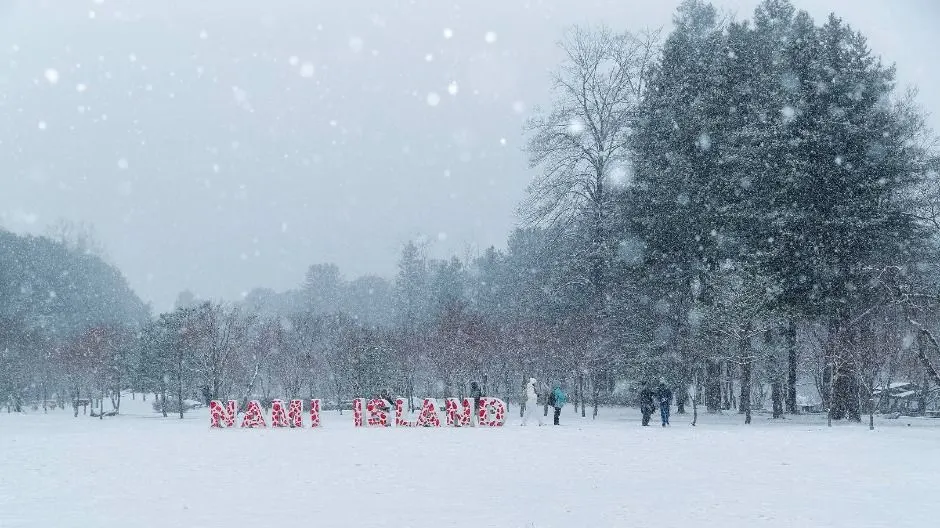
For a stretch of the mid-2000s, Nami Island was one of the most photographed places in Korea for a reason that had nothing to do with the island itself: it was where Bae Yong-joon and Choi Ji-woo walked the tree-lined lane in Winter Sonata (KBS, 2002), and Japanese, Taiwanese, and later mainland Chinese tour buses made the pilgrimage in numbers big enough to reshape the local economy of Gapyeong. That era is essentially over. The Winter Sonata cast statues are still there, the merch is still sold, and older tour groups still stop for the photo, but if you are visiting Korea in 2026 and you are not specifically hunting drama history, the reason to spend a half-day here is different. What's actually on the island now is a small, tightly designed park with a genuinely spectacular but very short autumn foliage window — and the whole visit calculus turns on whether you time it right.
What Nami Island actually is
Nami Island (Namiseom, 남이섬) is a half-moon-shaped river island of about 430,000 square meters in the Bukhangang River, administratively part of Chuncheon in Gangwon-do but accessed from Gapyeong on the Gyeonggi-do side. It wasn't naturally an island: the land was flooded in 1944 when the Cheongpyeong Dam raised the river level, leaving the higher ground surrounded by water. Before the dam it was a hill with a burial cairn traditionally attributed to General Nam-Yi (1441-1468), a Joseon-era commander executed at age 28 after being falsely accused of treason under King Yejong. The island is named after him.
The place has been a resort since 1966, when Min Byeong-do bought the island the year before and started planting the tree-lined lanes that would define the visitor experience decades later. In 2000 the operating company rebranded as Nami Island Co., Ltd. and in the mid-2000s it declared itself the 'Naminara Republic' — a self-styled micronation with its own passport-style tickets, currency notes, and stamps. It's a marketing conceit rather than an actual political entity, but it is committed to consistently enough that the ticketing, signage, and gift shop all lean into it.
The two-week foliage window is the real reason to come
The single most useful thing to know about Nami is that the autumn foliage is short. The tree-lined lanes — Metasequoia Lane, Ginkgo Tree Lane, and the Maple Garden — become genuinely photogenic tunnels of color from roughly late October through mid-November, with the visual peak concentrated in about a two-week window between mid-October and the first week of November. The ginkgos turn yellow around late October; once the local drop ends, the operator supplements the ground carpet with ginkgo leaves brought in from Songpa-gu (Seoul) to extend the effect into mid-November. That last detail is worth knowing: if you visit in the third week of November and the ground is still yellow, some of what you're seeing is trucked in, not fallen.
Outside that window the island is still pleasant — cherry blossoms in early to mid April, dense green in summer, snow-dusted lanes in January and February — but pleasant isn't the same as the two-week autumn effect, which is what actually justifies the KRW 19,000 admission for most first-time visitors. If you're building a Korea itinerary and Nami is on it, try to align the date. If the dates can't be moved, weigh whether a substitute like the Metasequoia Road at Damyang or Garden of Morning Calm's Autumn Morning Festival isn't a better fit.
Day trip vs. overnight: how to decide
The default plan is a day trip from Seoul. It works: ITX-Cheongchun from Yongsan or Cheongnyangni to Gapyeong (~1 hour), 10-minute taxi or the Gapyeong city tour bus to the wharf, ferry across, three to four hours on the island, ferry back, train home. Total round-trip time from central Seoul is about 6-7 hours including the crossing, of which 2.5-3.5 hours is actually on the island. That is enough time to walk all the main lanes, sit for a coffee, and see the Song Museum or Picture Book Playground once each. It is not enough time to bicycle the perimeter, eat a full lunch, and shoot photographs seriously.
The case for staying overnight is specifically about the first ferry and the last ferry. The island opens at 08:00 but the day-tripper crowd doesn't really arrive until 10:00-11:00; the last ferry off in high season is around 21:00-21:40 but most day-trippers leave by 17:00. That means guests at Hotel Jeonggwallu (the on-island hotel) or one of the campsite/glamping options get roughly two morning hours and three evening hours largely to themselves. In autumn peak, when the day-trip crowd on the main lanes is genuinely dense, that difference is significant. Outside autumn peak, the crowd delta is smaller and a day trip is honestly fine.
How to actually get there — and the zip-wire question
Standard access is the passenger ferry from Gapyeongnaru (Gapyeong Wharf). The crossing is about 5 minutes. Ferries run every 10-20 minutes between 09:00 and 18:00, with 30-minute intervals in the earlier 08:00-09:00 window. The KRW 19,000 admission ticket includes the round-trip ferry — you don't pay separately. Weekday evenings and Sunday nights extend service; check the operator's site for the exact last boat on the day of your visit.
The alternative is the Nami Island Zip-Wire, which launches from an 80-meter tower on the Gapyeong side and lands about 940 meters later on the island at roughly 56 km/h. It opened in 2010, hit peak Korean domestic popularity after appearing on '1 Night 2 Days' in 2016, and is priced at KRW 55,000 for the standard 5% slope or KRW 58,000 for the steeper 15% version. Both prices include the round-trip ferry and island admission, which is the detail most guides bury: if you were going to buy admission anyway (KRW 19,000), the marginal cost of the zip-wire is really KRW 36,000-39,000, not the full sticker price. Zip-wire hours are 09:00-19:00 April-October and 09:00-18:00 November-March. Weather cancellations happen.
If you're not driving and don't want to deal with train timing, the Gyeonggi/Gangwon shuttle-tour operators run Seoul-Nami-Petite France-Garden of Morning Calm combined day tours in the KRW 60,000-90,000 range that bundle transport, admission, and typically a lunch. For a single traveler with no car, these are usually cheaper than the sum of parts and the routing is efficient. For two or more travelers, the ITX + local taxi combination gives you more time control.
Pair it with Petite France or Garden of Morning Calm
Nami on its own doesn't fill a full day unless you're timing the light for photography. The standard Gapyeong pairing is Nami plus one of two neighbors. Petite France (10 minutes by taxi from Gapyeong Wharf) is a French-themed village used as a filming location for 'The Little Prince' installations and a number of K-dramas including 'Beethoven Virus' and 'My Love from the Star' — small, photogenic, about 60-90 minutes. Garden of Morning Calm (25 minutes by taxi/bus) is a large landscape garden that runs the Autumn Morning Festival roughly through October-November and the Lighting Festival December through March; it's the natural evening companion in winter.
If you have the fitness for it, the Gapyeong Rail Bike (~30 minutes away) is a 4-seat rail cart on the abandoned rail line above the Bukhangang River — a genuinely scenic hour rather than a filler stop. Gangchon Rail Park, on the same defunct Gyeongchun Line further toward Chuncheon, is the same idea and easier to reach from Chuncheon city.
Practical visitor information
Address: 1 Namiseom-gil, Namsan-myeon, Chuncheon-si, Gangwon-do (강원도 춘천시 남산면 남이섬길 1).
Ferry departs from: Gapyeongnaru (Gapyeong Wharf), Gapyeong-gun, Gyeonggi-do.
Island operating hours: 08:00-21:00 daily (extended during peak seasons). Last ticket sale approximately 18:00.
Ferry schedule from Gapyeong Wharf: 08:00-09:00 every 30 minutes; 09:00-18:00 every 10-20 minutes; extended evening service in high season. Schedule is subject to weather.
Admission (2026, ferry included): KRW 19,000 general · KRW 16,000 discount · KRW 13,000 special · free for children age 3 and under.
Nami Island Zip-Wire (admission + ferry included): KRW 55,000 (5% slope) · KRW 58,000 (15% slope). Hours 09:00-19:00 (Apr-Oct) and 09:00-18:00 (Nov-Mar).
Closed: none. The island operates year-round including public holidays.
Parking: about 600 spaces at Gapyeong Wharf. KRW 6,000 for small cars, KRW 10,000 for large; KRW 1,000/hour after 12 hours (waived for Hotel Jeonggwallu guests).
Contact: +82-31-580-8114. Website: namisum.com. Korea Travel Helpline: dial 1330 (English available).
- Aim for mid-October to the first week of November for the two-week autumn foliage peak; if that window doesn't fit your trip, consider a substitute rather than an off-season visit.
- Ferry cost is bundled into the admission ticket — don't pay separately, and don't buy a third-party 'ferry pass' upsell.
- The zip-wire fee (KRW 55,000-58,000) includes admission and ferry, so the true add-on cost over standard admission is only about KRW 36,000-39,000.
- For photos without crowds, stay overnight at Hotel Jeonggwallu or use the first 08:00 ferry — the day-trip flood doesn't hit until around 10:30.
- Winter Sonata drama tourism is largely finished; the cast statues are a photo op, not the reason to visit.
How long do I need on Nami Island?
A focused visit is 2.5-3.5 hours: walk Metasequoia Lane, Ginkgo Tree Lane, and Maple Garden, one museum (Song Museum or Picture Book Playground), and a coffee stop. Photographers or families with young kids should budget 4-5 hours. Full-day only makes sense if you're pairing it with cycling the perimeter or overnighting on the island.
Is the Winter Sonata connection still worth seeing?
For fans, yes — the tree-lined lane where the drama was filmed is preserved and the cast statues are marked. For general visitors in 2026, no. The active drama tourism era ended more than a decade ago, and the island has moved on to a broader park-and-foliage identity.
Can I go without a Korean tour package?
Yes, easily. Take ITX-Cheongchun from Yongsan or Cheongnyangni to Gapyeong Station (~1 hour), then a 10-minute taxi or the Gapyeong city tour bus to Gapyeongnaru wharf. Buy the KRW 19,000 admission ticket (ferry included) at the wharf. No advance reservation is required except in autumn peak weekends.
What if I'm coming outside autumn peak?
Cherry blossoms in early-to-mid April, cool green in June-August, and dusted snow in January-February are all pleasant but not the reason the island became famous. If your Korea trip falls in July or August, weigh whether Petite France plus Garden of Morning Calm without Nami is a better use of the day.
Is the zip-wire worth it?
The ride is about 940 meters at ~56 km/h — a real ride, not a novelty. The economics are decent because admission and ferry are bundled in. Weather cancels it, and there's no discount if the return ferry replaces it, so check conditions before you queue.
Is Nami Island in Seoul?
No. It's in Chuncheon, Gangwon-do, accessed from Gapyeong (Gyeonggi-do). From central Seoul, budget 60-90 minutes each way by ITX-Cheongchun train plus a short taxi to the wharf.