Seasonal
Haeundae Beach in October: Walking Guide
Walk Haeundae after the summer crowds leave, when the swim ropes come down and Busan's skyline and film-festival season reshape the beach.
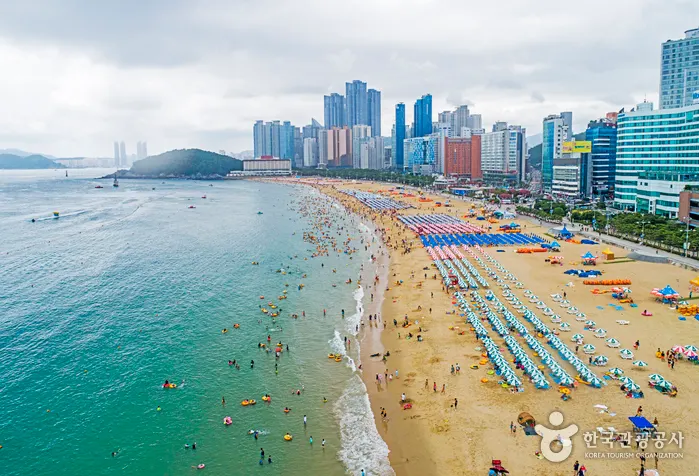
Every guide to Busan tells you to visit Haeundae Beach in July or August. What they leave out is what happens when 10 million people show up over the course of eight weeks on a strip of sand that's 1.46 kilometers long and 40 meters wide. What they also leave out is that the skyline behind the beach isn't the same skyline it was five years ago. The completion of the 411-meter LCT Landmark Tower in 2019 (Korea's second-tallest building) and the Marine City cluster to the west turned Haeundae into something closer to a Miami or Gold Coast night view than the fishing-village-turned-resort it started as in 1965. And the month to see that version of it — without the swim ropes, the sunshade forest, and the shoulder-to-shoulder crowd — is October.
The summer version is a different beach
Haeundae's official swimming season runs roughly July 1 through August 31, though in recent years Busan has extended the coast opening as early as June 1. During that window the beach is exactly what the postcards show: parasols in tight grid formation (the beach set a Guinness World Record in 2008 with 7,937 umbrellas at once), lifeguard whistles, swim ropes at ~50 meters offshore, and a boardwalk crowd that thickens after sunset. Capacity is roughly 120,000 people simultaneously — and on the summer peak Saturdays, that number is not a theoretical ceiling. It's the reservation.
The Haeundae Sand Festival (typically the first weekend of June) and the Polar Bear Festival (a January cold-water swim event running annually since 1988) are the two other bookend crowd moments. The rest of the calendar, especially September through early November, is quieter — and that's when the beach starts working as a walkable coastline rather than a party venue.
Why October is the version worth flying for
Three things line up in October that don't in summer. First, the water and air temperature. Busan sits at 35°N latitude — roughly the same as Tokyo or Los Angeles — and October daytime highs sit around 20-23°C with sea temperatures still warm enough for a barefoot walk. It's the last month you can eat outdoors on the boardwalk without a jacket at night.
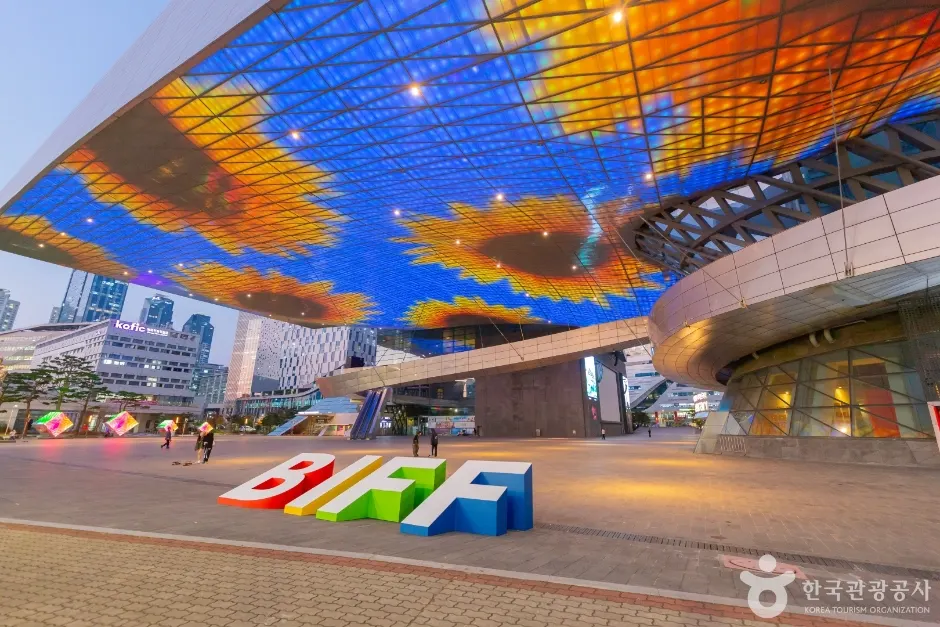
Second, the Busan International Film Festival (BIFF), Asia's largest film festival, holds its main week in early October each year. The festival is not just at the Busan Cinema Center in Centum City; it uses Haeundae as its outdoor stage. Red carpet events, celebrity sightings, outdoor screenings, and press setups occupy stretches of the beach and the boardwalk. The mood is closer to a film industry town than a resort — and unlike July, you can actually get a table at a Marine City restaurant on a Saturday night.
Third, the skyline finally reads. In direct summer sun and haze, the LCT tower cluster and the older Marine City high-rises just squint. At blue-hour and after dark in autumn, the entire western horizon of the beach turns into a light-column composition — and it's the view most travelers were quietly expecting when they booked Haeundae in the first place. Walk to the far eastern end of the sand (near Mipo) at sunset and look back west. That's the shot.
The one-day route: Mipo → Beach → Dongbaekseom
The mistake most first-time visitors make is treating Haeundae Beach as a single destination. It's actually the middle segment of a coastal walk that runs from Cheongsapo in the east to Dongbaekseom in the west, and doing the whole line in one day is the point.
Start at Mipo (미포), the small harbor at the eastern end of the beach. The Haeundae Blue Line Park Sky Capsule — the small two- to four-person elevated cabin cars that opened in October 2020 — departs from Mipo Station and runs about 2 kilometers along the coastal cliff to Cheongsapo, where you can visit the Cheongsapo Daritdol Observatory (a glass-floor walkway over the reefs). This is the newest attraction on the Haeundae coast and it books out on weekends; reserve online before you go. You can also take the slower Beach Train from Mipo, which continues past Cheongsapo all the way to Songjeong (~4.8 km).
Come back to Mipo, then walk the beach itself westward. It's 1.46 km end to end on flat sand — about 20 minutes at a relaxed pace, longer if you stop for coffee at one of the boardwalk cafés with second-floor views. At the western end, cross the boardwalk into Dongbaekseom (동백섬), the small former island — now connected to the mainland — that was designated a Busan monument in 1999. There's a loop trail around the perimeter (about 20 minutes) that passes camellia trees (dongbaek = camellia), a lighthouse, and Nurimaru APEC House.
Nurimaru is the traditional-style pavilion built for the 2005 APEC summit hosted by Korea. It's free to enter, the interior includes the actual summit conference room preserved as it was, and the terrace view back across the water toward Marine City and Gwangan Bridge is one of the best in the city. Budget 25-30 minutes.
Where to eat and what the neighborhood is really like
The Haeundae Market (해운대시장), one block north of the beach's central boardwalk section, is a covered street market — noticeably smaller than Busan's Jagalchi, but it's where the locals actually eat. The specialty is milmyeon (밀면), a wheat-noodle cold soup unique to Busan (Pyongyang refugees adapted it in the 1950s when North Korean buckwheat became unavailable). Order it with the added bibim spicy version if you can handle the heat.
Marine City to the west of Dongbaekseom is a different mood — waterfront restaurants under the high-rises, mostly Western/Italian, priced for the residential building demographic. Come here for the night view walk (the promenade under the towers looking back at Gwangan Bridge is a signature Busan image), not necessarily the food.
The back streets between Haeundae Station and the beach — a five-block stretch — are the old resort neighborhood: soju tents, grilled seafood, and 24-hour saunas. This is where budget travelers stay and where you'll find the closest thing to old-school Haeundae before Marine City happened.
Getting there and official visitor information
Address: 264 Haeundaehaebyeon-ro, Haeundae-gu, Busan (부산광역시 해운대구 해운대해변로 264).
Access: Busan Metro Line 2, Haeundae Station (해운대역), Exit 3 or 5, then walk south about 5 minutes. From Busan Station (KTX arrival), transfer at Seomyeon to Line 2 eastbound; total travel time ~45 minutes.
Hours: The beach itself is open 24 hours year-round. Official swimming season with lifeguards runs approximately July 1 through August 31 (Busan extends the coast opening earlier in some years). Sky Capsule and Beach Train (Haeundae Blue Line Park): typically 09:00-18:30 with seasonal variations; reserve at skycapsulebusan.com.
Admission: Free for the beach. Nurimaru APEC House: free. Sky Capsule: paid, tiered by cabin type and route (round-trip vs one-way).
Contact: Haeundae-gu tourism +82-51-749-7611. Official beach info: sunnfun.haeundae.go.kr.
- October (BIFF month, warm sea, sparse crowd) and late September are the smart windows. Avoid summer weekends unless the crowd is the point.
- The full coastal walk is Mipo → Haeundae Beach → Dongbaekseom (~3 km) plus optional Sky Capsule east to Cheongsapo. Give it a full afternoon, not an hour.
- Nurimaru APEC House on Dongbaekseom is free and includes the actual 2005 APEC summit room — 25 minutes well spent.
- The best skyline shot is from the eastern end of the beach (near Mipo) looking west toward LCT and Marine City at blue hour.
- Eat milmyeon (cold wheat noodles, a Busan-specific dish) in Haeundae Market, one block north of the boardwalk — not at a beachfront restaurant.
When is Haeundae Beach open for swimming?
The official swimming season with lifeguards runs approximately July 1 through August 31 each year. Busan sometimes extends the coast opening to June 1. Outside those dates the beach is open 24 hours year-round, but swim ropes and lifeguard supervision are not in place.
How do I get to Haeundae Beach from Busan Station or Gimhae Airport?
From Busan Station: take Metro Line 1 to Seomyeon, transfer to Line 2 eastbound to Haeundae Station (Exit 3 or 5), 5-minute walk south to the beach. Total ~45 minutes. From Gimhae Airport (PUS): take the light rail (BGL) to Sasang, transfer to Line 2, ride to Haeundae Station. Total ~70 minutes.
Is Haeundae worth visiting outside summer?
In our view, October is actually the better month — the Busan International Film Festival takes over the neighborhood, the crowds are gone, the temperature is 20-23°C, and the LCT-Marine City skyline reads clearly at blue hour without summer haze. Winter (except the January Polar Bear Festival weekend) is quiet but photogenic.
How does Haeundae compare to Gwangalli Beach?
Haeundae is longer (1.46 km vs Gwangalli's ~1.4 km), busier, and family-focused; the surrounding neighborhood is more traditional Busan mixed with luxury high-rise. Gwangalli is bar-and-café oriented with the direct Gwangan Bridge view. Most visitors do both in one Busan trip — they're 15 minutes apart by taxi.
Can I walk from Haeundae Beach to Nurimaru APEC House?
Yes. Nurimaru is on Dongbaekseom, the small former-island park at the western end of Haeundae Beach. From the beach's west boardwalk, cross into the park, follow the loop trail counterclockwise about 10 minutes to Nurimaru. Round trip including a visit is ~45-60 minutes.
What is the Haeundae Sky Capsule and is it worth it?
Opened October 2020, the Sky Capsule is a small elevated cabin car (2-4 persons) running about 2 km along the coastal cliff from Mipo (east end of Haeundae Beach) to Cheongsapo. It's the most photographed new Haeundae attraction; reservations are required on weekends. It's worth it once for the cliff view; the parallel Beach Train continues to Songjeong for those wanting a longer coastal ride.