Seasonal
Suncheon Garden and Wetland: One-Day Plan
Compare Suncheonman National Garden with the reed-field wetland 4 km away, including their different highlights and the SkyCube connection.
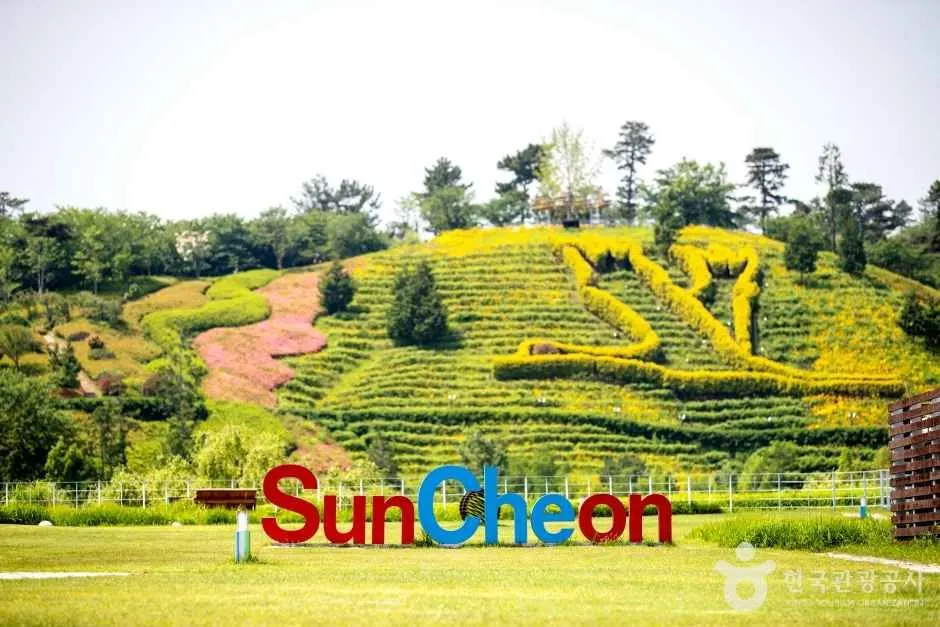
Search results for 'Suncheon Bay' throw two very different places at you and don't always tell you they're different. One is Suncheonman National Garden — a 1.12 km² landscaped park with a tulip-lined main axis, a World Garden zone built by eleven countries, and a small monorail. The other is Suncheonman Bay Wetland Reserve — 35.5 km² of Ramsar-designated tidal flats and reed field about 4 km south, where hooded cranes overwinter. Same city, same brand name in Korean, entirely different experiences, separate tickets. This guide covers the garden, but only makes sense once you understand where it sits in relation to the wetland — because the whole reason the garden was built here at all was to keep the wetland alive.
Why the garden exists — and why it's Korea's National Garden No. 1
Suncheon's tidal wetland has been drawing attention since the late 1990s, and once Suncheon's boundary began pushing south toward it, planners had a problem. The bay's ecological value depends on the buffer around it staying undeveloped — housing, roads, and light pollution advancing south would end the annual bird migration. The city's answer was to build a designed landscape between the city edge and the wetland, dense enough with trees and gardens to act as a physical firewall against sprawl. That landscape became the Suncheon Bay International Garden Expo site in 2013, and it stayed open after the expo closed.
The 2013 expo ran April 20 to October 20 and pulled in over 4.4 million visitors. Two years later, in August 2015, the Korean government formally designated Suncheonman National Garden as the country's National Garden No. 1, with the proclamation ceremony on September 5. The 'No. 1' isn't marketing — it's the sequence number of the national garden registry. The category was created for this site. Everything else (Ulsan Taehwagang, subsequent designations) came after. Reading the garden as a public-works buffer rather than a botanical showcase changes how the layout reads once you're inside.
The garden vs. the wetland: what you actually see at each
Suncheonman National Garden is designed. Paths are laid out, plantings are curated, and the whole 1.12 km² site is walkable in a leisurely afternoon. Roughly 790,000 trees across 505 species and 3.15 million flowers across 113 species are worked into four zones: the Arboretum (meditation and maple paths, a traditional Korean garden, a royal azalea collection), the Wetland Center (Dream Bridge, indoor wetland exhibits, and the SkyCube station), the World Garden zone (eleven country gardens including Germany, the Netherlands, Japan, and Spain, each executed by that country's landscape team), and the Wetland Zone that transitions the site toward the natural bay. The visual grammar is intentional and photographable — this is where the tulip fields, topiary, and seasonal illumination live.
Suncheonman Bay Wetland Reserve is nothing like this. It's 35.5 km² of tidal flat and reed field, Ramsar-registered on January 20, 2006. The interior is 230 hectares of continuous reed grass — one of Korea's largest continuous reed communities — surrounded by 2,221 hectares of tideland. There's a boardwalk out over the mud, an observatory hill (Yongsan) with the well-known aerial view of the S-curve channel, and a boat that runs when the tide is right. The wildlife is why serious visitors come: hooded cranes, whooper swans, and Chinese egrets overwinter here, mostly November through February. There are no plantings, no country gardens, no lighting design. It's a working ecosystem you're walking across on a raised path.
Confusion between the two is common because the Korean name (순천만, 'Suncheon Bay') is shared and because the SkyCube monorail links them. If you turn up at the garden expecting mudflats, or at the wetland expecting tulips, you'll be disappointed — and the garden's ticket doesn't cover the wetland.
SkyCube: the monorail that makes doing both in one day realistic
The SkyCube is a personal-rapid-transit style monorail that runs from the garden's Wetland Center station out to the Suncheon Bay Ecological Park (the wetland side). It's the reason a single-day 'garden plus wetland' trip is straightforward rather than requiring a taxi transfer. Small cabins run on an elevated guideway; the ride itself is short and functional, not a scenic attraction. The value is the timing — you can walk the garden in the morning, ride out to the wetland for the late-afternoon light on the reeds, and be back at the garden's parking lot before it closes.
The SkyCube ticket is separate from the garden admission and separate from the wetland admission. Combined tickets covering all three are usually sold at the main garden ticket booth; ask for the 'integrated' or combo ticket. If you're only visiting one side, you don't need it.
Which season, which side
The two sites peak on opposite calendars, which is the single most useful thing to know when planning. The garden peaks in late April to early May for tulips and again in late May to June for the rose and azalea collections. Summer is green and full but the light gets harsh. Autumn (mid-October to mid-November) brings cosmos, sunflowers, and the maple paths in the Arboretum. Winter, the garden runs an evening illumination — night ticket, half price after 17:00 — and this is when the topiary and country-garden lighting come alive.
The wetland peaks in late October to mid-November for the reed field — the grass turns silver-gold and catches wind in a way no designed landscape can imitate — and again in December to February for the overwintering cranes and swans. Spring at the wetland is uneventful. Summer is birdless and mosquito-heavy. If you're deciding between the two on a single visit, use the season: garden in spring, wetland in autumn, both together in mid-November when the reed field is still gold and the garden's chrysanthemums are up.
How to walk the garden efficiently
The garden is bigger than it looks on the map. From the East Gate ticket booth to the far side of the World Garden zone is about 25 minutes at a normal walking pace. Trying to see every country garden turns into a slog. A better approach: pick the World Garden zone as your main focus (roughly one hour there, including the country gardens you actually want to see — the Netherlands and Japan zones are the most visited for good reason), then the Arboretum as your second block (45 minutes for the traditional Korean garden and one of the meditation paths), and skip the Wetland Center indoor exhibits unless you have children with you or are waiting for a SkyCube departure.
The Dream Bridge, a covered walkway lined with 145,000 children's drawings on shipping-container panels, is worth crossing once for the concept but doesn't need a second lap. If you're photographing, mid-morning and the hour before sunset give the best light — the middle of the day flattens the topiary.
Official visitor information
Address: 47 Gukgajeongwon 1ho-gil, Suncheon-si, Jeollanam-do (전라남도 순천시 국가정원1호길 47).
Opening hours: October to June 09:00-20:00 · July to September 09:00-21:00. Last admission 19:00.
Closed: Last Monday of every month.
Admission: Adult KRW 10,000 · Youth KRW 7,000 · Child KRW 5,000. Night ticket (after 17:00): Adult KRW 5,000 · Youth KRW 3,500 · Child KRW 2,500. Group rates (20 or more): Adult KRW 6,000 · Youth KRW 5,000 · Child KRW 3,000. Suncheonman Bay Wetland Reserve is a separate ticket. Combined 'integrated' tickets covering garden, SkyCube, and wetland are sold at the main ticket booth.
Contact: +82-61-749-3114. Official English overview: english.visitkorea.or.kr (search Suncheonman National Garden).
Getting there: KTX to Suncheon Station (roughly 2h 40m from Seoul Yongsan), then local bus 66 or 67 to the garden's East Gate (about 20 minutes). Taxi from Suncheon Station to the East Gate is 10-15 minutes.
- The garden and Suncheonman Bay Wetland Reserve are two different sites 4 km apart with separate tickets — clarify which one you're booking.
- The SkyCube monorail connects the garden's Wetland Center to the wetland's Ecological Park; buy the integrated combo ticket if you're doing both.
- Season decides which side to prioritize: tulips and roses at the garden in April to June, reed field and cranes at the wetland from late October through February.
- The garden is closed on the last Monday of every month — a common trip-planning mistake.
- After 17:00 the night ticket is half price and the illumination season (winter especially) is when the country gardens and topiary look most distinct.
Is Suncheonman National Garden the same as Suncheon Bay Wetland?
No. They share the Korean name '순천만' (Suncheon Bay) and are both in Suncheon, but they are two separate sites about 4 km apart. The National Garden is a 1.12 km² designed landscape with 505 tree species and eleven country gardens. The Wetland Reserve is 35.5 km² of Ramsar-designated tidal flat and reed field with migratory birds. Different tickets, different reasons to visit.
Can I visit both in one day?
Yes, and this is the standard trip. The SkyCube monorail runs from the garden's Wetland Center station out to the Suncheon Bay Ecological Park, so no car or taxi is needed between them. Buy the integrated combined ticket at the garden's main booth. Plan on 3-4 hours at the garden and 2-3 hours at the wetland, including the walk out on the boardwalk.
Why is it called 'National Garden No. 1'?
In August 2015, Korea created a national garden registry and Suncheonman was designated as the first entry — literally No. 1 in the sequence, with the proclamation ceremony on September 5, 2015. The category was created for this site after the success of the 2013 Suncheon Bay International Garden Expo, which drew 4.4 million visitors between April 20 and October 20 that year.
When is the best time to visit?
For the garden alone, late April to early May (tulips) or mid-October to mid-November (cosmos and maple paths). For both sites in one visit, mid-November — the reed field at the wetland is peak gold, the garden's autumn plantings are still up, and the evening illumination is starting for the night-ticket window. For the wetland's overwintering cranes, come December through February.
How long should I budget?
The garden alone is 3-4 hours if you focus on the World Garden zone plus one Arboretum path. A full walk of every country garden and every trail pushes 6 hours. Adding the SkyCube and the wetland brings the day to 7-8 hours total, so start by 10:00 if you want both.
Is it worth going in winter?
For the illumination and half-price night ticket after 17:00, yes — the country gardens and topiary read very differently under lights than in daylight. For the reed field or bird migration at the wetland, absolutely yes. For daytime flower photography at the garden, no — most beds are dormant.