Seasonal
Oedo-Botania: A 90-Minute Island Plan
Learn how one couple built Oedo-Botania over four decades, then follow a walking order designed for the ferry's roughly 90-minute island stop.
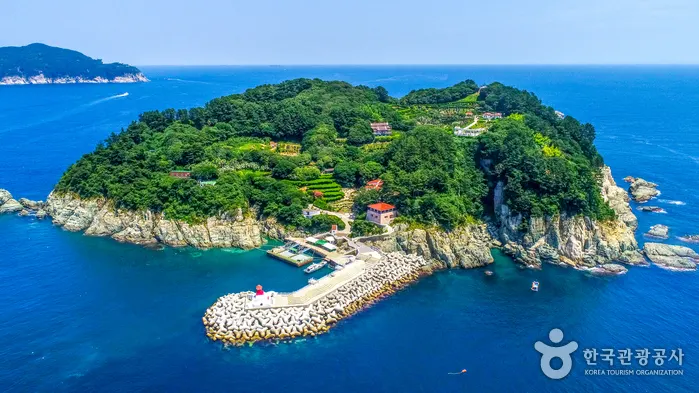
Most guides describe Oedo-Botania as 'a botanical garden on a small island off Geoje.' That description is technically correct and completely misses the point. Oedo is 4 hectares of rock sitting 4 kilometers off Geoje's southeast coast, and in 1969 a fisherman named Lee Chang-ho and his wife Choi Ho-sook bought most of it. Over the next four decades they hauled soil, built terraces, planted more than 3,000 species of plants, and turned an uninhabited crag into a Mediterranean-style garden that opened to the public in 1995. What you are walking through when you visit is one family's forty-year private project, still privately owned. That fact changes how the visit reads, and — because the ferry only gives you about 90 minutes on the island — it should also change how you walk it.
Why this island exists in this shape
In 1969 Lee Chang-ho was caught out on his oyster boat by a storm and took shelter on Oedo, a rocky offshore island in Hallyeohaesang National Park that had no electricity, no telephone line, and eight households of subsistence farmers. He liked it enough to eventually buy most of the island. He and Choi Ho-sook tried tangerine orchards. Tried pig farming. Both failed against salt spray and thin soil. Around the mid-1970s they pivoted to ornamental horticulture — a formal cultivation plan was approved by the local government in 1976 — and began the slow work of importing subtropical plants, terracing the slopes, and building the paths and pavilions.
They opened the garden to paying visitors in 1995, roughly 26 years after settling there. The garden is still family-run and still privately owned; admission and ferry revenue fund maintenance. That is unusual in Korea, where most large gardens are municipal or attached to temples. It's also what gives Oedo-Botania its aesthetic — the design vocabulary is deliberately not Korean traditional. There are Greek-style statues in the Venus Garden, palm-lined promenades, a cactus garden, a camellia grove, and formal European-style parterres. On a national-park island off the south coast of Korea, that reads as either wonderful or slightly surreal depending on your taste, and both readings are valid.
The 90-minute constraint — and the walking order that fits it
Ferries to Oedo run round trips: they drop you off, then a later boat picks you up. In practice you get about 90 minutes on the island — long enough to walk the garden loop once with brief stops, not long enough to linger over lunch or do the loop twice. Missing your assigned return ferry is a real problem; boats are timed to visitor turnover and there is no lodging on the island.
The walking order that works: as soon as you land, climb straight up. The island uses eight interconnecting paths, and most people default to the wide central promenade, which means the Venus Garden and the main viewing plaza get shoulder-to-shoulder crowded in the first 20 minutes after a ferry lands. If you go up the left-hand path first — toward the highest observation deck — you gain 15 minutes of relative quiet at the top view (the one over the sculpture terrace with the ocean behind) before the crowd catches up. Come back down through the Venus Garden and the cactus section on your way to the boat. This is the reverse of what most visitors do and it is the whole trick.
Budget 60 minutes for the walking loop and 20-25 minutes buffer to reach the ferry point. Do not try to eat a full meal here; there are cafes and light snacks, but the queues around ferry departure eat any margin. Eat before you board in the morning.
Which ferry terminal to leave from
Four terminals on Geoje run ferries to Oedo: Jangseungpo, Wahyeon, Dojangpo, and Haegeumgang. They all charge similar fares — roughly KRW 16,000-19,000 round trip for adults, roughly KRW 9,000-11,000 for children — and they all combine the Oedo drop-off with a scenic cruise past the Haegeumgang rock formations (Geoje's other headline sight). The difference is sailing time and convenience.
Jangseungpo is the most common choice — the largest terminal, the most departures per day, and the easiest to reach by bus or taxi from downtown Geoje or from Busan. Sailing time is roughly 40-50 minutes each way including the Haegeumgang cruise. Dojangpo is the closest port to Oedo — the direct crossing is about 30 minutes — so if you value time on the island over the boat tour, this is the pick. Haegeumgang and Wahyeon are smaller, more scenic terminals on the southeast coast; they suit you if you are already staying nearby (Windy Hill / Sinseondae area) and want to skip the drive back to Jangseungpo.
Book the ferry the day before in high season (July-August and autumn foliage weekends). Weekday sailings usually accept walk-ups. Rough seas cancel service without much warning — build a fallback day into your Geoje itinerary between June and September when typhoons and summer squalls can shut the harbor.
When to go — the honest seasonal breakdown
Oedo works differently in each season and the marketing photos don't tell you that. April to early June is the peak — camellias in early spring, then azaleas, then the palms and subtropical plantings looking their most convincingly Mediterranean. This is also the most crowded window; expect the Venus Garden to be crowded from the first ferry of the day.
Mid-summer (July-August) is hot, humid, and the light is harsh — the garden looks its most lush but photographs poorly, and ferry cancellations from summer storms are highest. September to late October is the sleeper pick: temperatures drop, the light softens, and the mixed subtropical foliage turns into the shoulder-season quiet nobody photographs. Winter (December-February) is the least-visited window and some plantings look bare; on the other hand you may have the observation deck to yourself, and the sea views over Hallyeohaesang are at their clearest. The garden closes only on the eve of Seollal and Seollal itself.
How Oedo fits into a Geoje day
Oedo alone is a half-day: allow 3-4 hours end to end from Jangseungpo, including boarding, the Haegeumgang cruise, the 90 minutes on the island, and the return. That leaves the second half of the day for the southeast coast loop.
The natural pairing is Haegeumgang itself (the twin-rock islet you already circled on the boat) plus Woojebong / Windy Hill (바람의 언덕), the grassy headland with the small white windmill, and the Sinseondae Observatory cliffs. All three sit within a 15-minute drive of Haegeumgang village and are easy to string together by car or a scheduled shuttle. If you have time for a beach stop, Hakdong Black Pearl Beach on the south coast is the pebble beach with the distinctive dark, rounded stones.
For visitors coming from Busan for the day: KTX to Busan Station, then a coach from Busan Sasang or Nopo terminal to Geoje / Jangseungpo (roughly 90 minutes). Boarding at 09:30 gets you back to Busan by early evening. Overnighting in Geoje makes the pairing much easier — Jangseungpo and Gohyeon have the most accommodation.
Official visitor information
Address (Oedo-Botania office / ticketing reference): Irun-myeon, Geoje-si, Gyeongsangnam-do, Republic of Korea. The island itself sits roughly 4 km east of Hakdong / Haegeumgang on the Geoje coast.
Opening hours (island): Summer (roughly March-October) 08:00-19:00 · Winter (roughly November-February) 08:30-17:00. Last ferry departure from Geoje is well before closing — check the ferry operator's timetable, not just the island hours.
Closed: The eve of Seollal (Lunar New Year) and Seollal itself. Otherwise open year-round. Individual ferry sailings can be canceled by sea conditions with short notice.
Admission (paid on Geoje-side terminal, usually bundled with the ferry ticket): adults KRW 11,000 · youth (13-18) KRW 8,000 · children (7-12) roughly KRW 5,000 · under 2 free. Round-trip ferry fare varies by operator, roughly KRW 16,000-19,000 for adults.
Access: Ferries from Jangseungpo (main), Wahyeon, Dojangpo, and Haegeumgang terminals on Geoje. Nearest KTX station is Busan; from Busan, coach to Geoje / Jangseungpo takes roughly 90 minutes.
On-site: Cafes and snack kiosks. No lodging. No pets permitted. Stroller and wheelchair access limited — the garden is built on a steep slope with stone steps as the primary connectors.
Official site: oedobotania.com. Korea Travel Helpline +82-2-1330 (English).
- Walk the loop counterclockwise — go up the left-hand path first to the top observation deck, then descend through the Venus Garden after the crowd has moved.
- Ferry-side admission bundling: adult ticket is roughly KRW 11,000 for the island plus KRW 16,000-19,000 round-trip ferry, usually paid together at the Geoje-side terminal.
- Dojangpo has the shortest crossing (30 min); Jangseungpo has the most departures. Pick by whether you value more island time or more flexibility.
- Rough seas cancel ferries — build a fallback day into your Geoje itinerary in July-September and check the weather before you leave the hotel.
- Do not plan to eat lunch on the island. Eat before you board; there's food but the return-ferry queue will eat any margin.
Is Oedo-Botania a Korean traditional garden?
No. It is a Mediterranean- and subtropical-style ornamental garden designed and built by one Korean couple, Lee Chang-ho and Choi Ho-sook, starting in 1969 and opened to the public in 1995. The design vocabulary — Greek statuary, palm-lined promenades, cactus terraces — is deliberately European and subtropical, not Korean vernacular. It sits inside Hallyeohaesang National Park but the garden itself is privately owned.
How long does the visit actually take?
Ferry timetables give you about 90 minutes on the island. Total round-trip from a Geoje terminal (including the Haegeumgang scenic cruise) is roughly 3-4 hours. From Busan by coach and back, budget a full day.
Which ferry terminal should I choose?
Jangseungpo for the most departures and the easiest transit connections. Dojangpo for the shortest sailing (about 30 minutes) if you want maximum time on the island. Haegeumgang or Wahyeon if you are already staying on Geoje's southeast coast and don't want to backtrack.
Can I visit in winter?
Yes — the garden closes only on the eve of Seollal and Seollal itself. Winter hours are shorter (08:30-17:00) and some plantings look bare, but the light is clearest and crowds are the thinnest of the year. Ferries still run in most weather; check the sea forecast.
Is it worth going if I've seen European botanical gardens?
Yes, but for a different reason. Oedo is small — 4 hectares — and if you judge it as botanical taxonomy against Kew or Villa d'Este, it is a modest collection. The interest is that a private Korean couple built a Mediterranean garden on a barren offshore rock over four decades. It reads as a personal project, not an institutional collection, and that is the visit.
Are strollers, wheelchairs, or pets allowed?
The garden is built on a steep slope with stone steps as the main connectors, so stroller and wheelchair access is very limited. Pets are not permitted on the island. There are no stroller rentals on-site.